

Super Mario Kart 8 Deluxe Switch
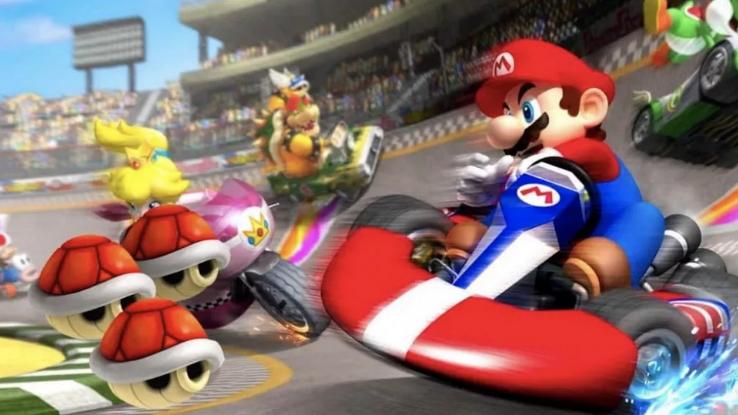
Film this: Yous're participating in an important race — and losing — when all of a sudden an outside force changes the momentum so that yous have a run a risk to come up out on pinnacle. Now, flick most winning a race when an outside force knocks you out of place and you finish in a dissimilar position. This, more often than not, summarizes the gameplay experience of i of Nintendo's nearly popular video game franchises, Mario Kart.
One more scenario to visualize: Motion-picture show yourself near winning a race. No outside strength hurts your continuing on the course, and outside forces, if anything, help you finish beforeeveryone else. The gap betwixt get-go and last is then large that the audience exits before the person in last place crosses the finish line. This, while oversimplified, is how economies function in countries and communities all over the globe. And that was before the COVID-19 pandemic stratified things fifty-fifty more.
With economies in unstable flux after a year of quarantining, more experts are looking for unlike models to inform a new economy that brings equity to more people. Nature, a publication dedicated to studying the environment and researching policies that create a more equitable Earth, recently published findings from Boston University professor Andrew Reid Bong. Bell's study looked into the means Mario Kart's features could actually serve as a model for a improve economic future.
What the inquiry also found is that nosotros demand are more blue turtle shells. Ruby shells, also. And even some lightning bolts. All of these are items in the Mario Kartfranchise that confer benefits to players — and, interestingly, they're items that need to be translated into economic policy in some way or another. Hither's what that means and how it might happen.
A Crash Form in Mario Kart's Game Design
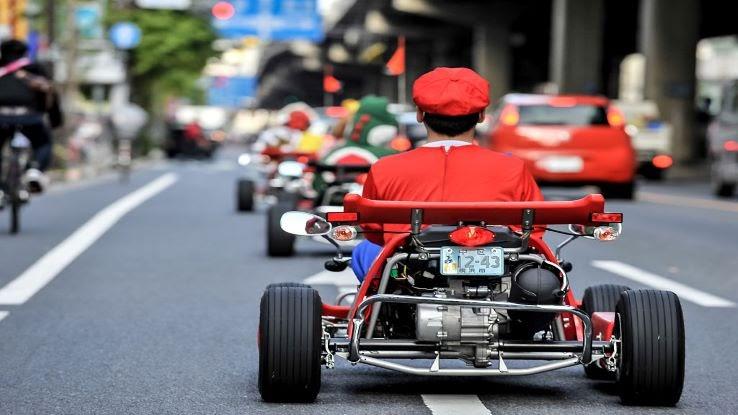
The showtime game in the Mario Kartfranchise was released in 1992 for the Super Nintendo Entertainment System (SNES). In its near 20 years on Earth, its formula hasn't changed much. Competitors race against each other, playing as some of their favorite characters from the Super Mario Bros. franchise.
To make the races more interesting, unpredictable and competitive, players can collide caput-on into irised blocks that hold different items inside — items that range from assistant peels that make another player spin out to speed boosts to turtle shells that make another player crash. While traveling around tracks with names similar "Cheese State" and "Donut Plains," players also find boosts like invincibility stars and lightning bolts that make all other players shrink and slow downward for a few seconds. The beat colors are spring past some cardinal rules, too. Green turtle shells launch in whatever direction a player deploys them to, red shells travel direct to the next-closest player in range and blue shells target the person who's in first place.
Why do these power-ups affair? Not long after playing the game, information technology's not abnormal to notice a blueprint in how the items are distributed. The quality, force and type of advantageous item a player receives depends on their position in the race — just not in the way you might call up. The players in the pb are more likely to receive less-helpful items like banana peels, and the players on the tail cease are more likely to to receive game-changing items like lightning bolts or stars that help them accelerate much faster.
This system of item distribution makes it intentionally difficult for any one player to maintain a commencement-identify lead. The game's design as well makes it possible for someone in last identify to come out on top. Folks in the middle of the pack could too become one way or another.
These races, normally lasting around five minutes each, are competitive but too fun. Skill is still a factor, but when information technology comes to take a chance, the odds aren't stacked for or against whatever item actor. If these races didn't take an ending — if they just went on and on while more players joined and other players left — what would that look like? Moreover, what would a gild run like that start to look like? That's part of what Bell'due south inquiry aimed to find out — and what he discovered was that giving similar power-ups in the grade of directly assistance to low-resource farmers in the developing world could assistance reduce poverty overall.
Allow's take a minute to discuss safety bands. They're made of prophylactic, and they tin can stretch out if you pull on them. Stretch a ring out too far and information technology might break. It'south simple plenty, but this everyday item makes a great metaphor. In this instance, rubber banding, or "rubber band theory," tin can be applied to both game design and systems of economics.
It's no secret the global economy is experiencing some massive shifts, peculiarly in the wake of the pandemic. CBS News reports that from March 21, 2020 to March 21, 2021, the wealth of the globe'due south billionaires increased from $viii.04 trillion to $12.39 trillion. One example? Jeff Bezos' wealth rose from $113 billion to $178 billion — an increase of 54%. Few can say they've seen a similar increase in their own wealth, pct-wise, particularly during the pandemic, and this farther highlights how wealth gaps are growing globally.
When it comes to video games, and designing competitions in general, the resistance or friction that occurs when pulling dorsum a safety band is mimetic of a skillful sport. Winning feels amazing, but winning despite a hard-fought struggle is what keeps players coming back to their games and pursuing progressively more challenging levels and titles equally they keep to play and beat each one.
People love watching close games — triple overtimes with a back and forth. The same principle applies to video games. If y'all flit into a dungeon and save a princess with no enemies to fight, puzzles to solve or other adversity to confront, are yous really going to "save and keep" your way through more of the same? This is also why games go harder as you progress through them. Equally you learn how to play, the skills you lot develop are put to the test flake by bit until the game culminates with a final boss.
Similarly, Nintendo created a game that makes players desire to hit the tracks again and again — they never know what new power-up they might receive to change their race result for the meliorate. The game'south objective is not to "go" anywhere specific only progress in difficulty and beat your own tape. This is where the items and the Mario Kartprinciple come into play. Running over a banana peel and beingness struck by lightning are elements that keep someone playing. That "rubber band" is pulled back a bit. A victory despite the challenge of facing other racers is what truly satisfies players.
This rubber band philosophy can likewise be practical to economics. In that location's the forcefulness that happens when the ring is pulled back that mimics the friction of life and, in most cases, the piece of work that needs to be washed to progress economically. Just besides nowadays is the idea that, if a rubber band is pulled back far enough, information technology'll shoot frontwards in the direction it'southward pulled in.
And then, if ane is doing well financially or in life, that rubber ring is loading up and is near to be (figuratively) shot forwards. When things aren't going the best — or, say, someone's playing a video game and hasn't quite hit the skill levels needed to win the game — that band would be shot to a lower level, in theory.
With income inequality in its current state — the Un explains it's "risen in a startling number of countries" over the past 30 years — one could contend that the condom band has broken. If at that place were more checks and balances to go on people closer in line to each other, economically speaking, wouldn't everyone come up out on top?
Consider 2020 and the COVID-19 pandemic. Mario Kart eight Deluxe for the Nintendo Switch sold x.68 meg copies from April 2020 to March 2021. When humanity could not get out their homes, they needed something just as satisfying as viral soap-cutting videos that they could put hours and hours into. People tin can gravitate towards struggle in situations where they demand satisfaction and something worthy of their fourth dimension. If people tin enjoy Mario Kart this much in their leisure fourth dimension, what if nosotros applied its design to different methods of life?
The Equitable Environments of Mario Kart Economics
As it turns out, Mario Kart might make a model for more economical inspiration. Experts are also hoping to utilize this system to better regulate the environment, an idea that Bell's findings as well support.
Bell argues that if leaders enact policies that help farmers in rural, developing regions or those that lack access to food, the world would be greener and more equitable. This could mean supporting urban farmers in cities, specially in neighborhoods with food deserts. Information technology could also hateful providing more monetary support for rural areas where people have to travel far to reach nutrient. What if, instead of turtle shells, we gave farmers healthcare, financial incentives to adopt greener farming practices, and other forms of support necessary to empower communities?
Farmer's markets empower local communities, then being able to bring that type of energy and those opportunities to areas that don't go to feel them could be vital for helping those groups (and the planet) thrive. If nutrient sources get as local as possible, less money and fewer resource like fossil fuels would need to be used to haul food on highways across the world. In that location are programs that assist farmers already, sure, only we may need more of them. Maybe, to put information technology in Mario Kart terms, we demand to offer more lightning bolts and stars compared to the banana peels and turtle shells that haven't helped in intended ways.
If children can learn and love Mario Kart, could we employ the same strategy to set systemic economic problems? It may take a few golden mushrooms and bolts of lightning, but a Mario Kart strategy for public policy might exist the track we need to follow for a better tomorrow.
Source: https://www.ask.com/culture/mario-kart-formula?utm_content=params%3Ao%3D740004%26ad%3DdirN%26qo%3DserpIndex&ueid=65992cb6-87ad-482d-ac38-033c9ee9ef17
Posted by: torreslitarly.blogspot.com
0 Response to "Super Mario Kart 8 Deluxe Switch"
Post a Comment